

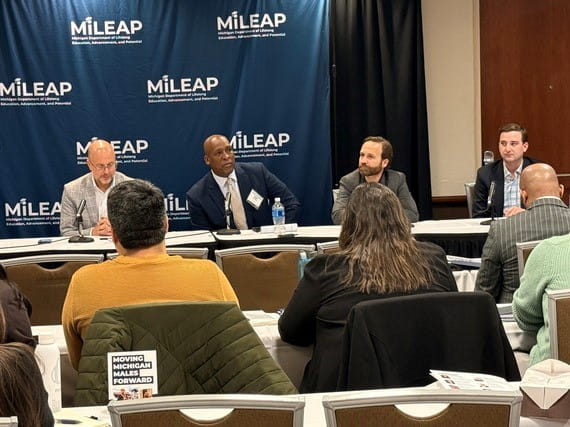
Last month, I attended the MILeap (Michigan Department of Lifelong Education, Advancement, and Potential) conference focusing on the widening deficit of men moving into college or higher education.
Moving Michigan Males Forward is an initiative stemming from Governor Whitmer’s executive directive to create more opportunities for men.
Some of you might be scratching your heads.
For many of us, our bias is that men are the majority everywhere because that is historically what we have seen.
The truth is, enrollment of men in higher education has been quietly declining since 2011 when they comprised 47% of enrollment in higher education. Recent numbers show only 42% of higher ed students are male.
This is not a zero sum game.
While this new directive focuses on men, speakers at the MILeap conference emphasized this is not a focus on men at the expense of lifting up other learners.
For example, we still need to see women in STEM. But we also need to see men in the HEAL economy.
Keynote speaker Richard V. Reeves defined HEAL as “the caring economy,” such as health, education, literacy, and social work. Like the work done with STEM, the more boys and young men can see men in these roles, the more likely they are to consider pursuing work in those fields.

This is important as we have seen an increase in the gender gap in professions like teaching. Currently, 77% of teachers are female, in elementary school that number is 89%.
That is all to say as boys are going through their most formative period, they are not seeing a lot of teachers who look like them.
Looking at nursing only 12% of licensed nurses are men. Men account for only 18% of social workers and 20% of psychologists. When young men face any issues, especially with mental health, they are again not seeing themselves.
The takeaway from the conference is we have taken male participation for granted, but we see that has not served men or society well. These professions where there is a noticeable lack of men are also professions where we see worker shortages in Michigan.
The decline in male participation in all of higher education is a sign that we need to nurture learners of all kinds and no one group should be left out.